

Climate change is no longer a distant threat—it’s here. From record-breaking heatwaves to devastating floods and wildfires, the planet is experiencing the consequences of a warming world. But while we can’t reverse time, we do have tools to shape the future. Two key strategies guide our response: adaptation and mitigation. Both are essential, but they serve different purposes. United Nations Framework Convention on Climate Change (UNFCCC) and the Intergovernmental Panel on Climate Change (IPCC) has defined the different approaches as:
Adaptive capacity is the ability of systems, institutions, humans, and other organisms to adjust to potential damage, take advantage of opportunities, or respond to consequences associated with climate change (IPCC, 2022)
Mitigation capacity is the ability of a system, including institutions, societies, and economies, to reduce greenhouse gas (GHG) emissions or enhance carbon sinks through technological, economic, social, and policy interventions (IPCC, 2022)
Adaptation is about adjusting to the impacts of climate change that are already happening or are inevitable. Think of it like preparing for a storm—strengthening buildings, improving early warning systems, or redesigning cities to handle extreme weather. A region’s adaptation capacity depends on factors like infrastructure, governance, technology, and financial resources. Wealthier countries often have more resources to adapt, while vulnerable communities struggle with fewer options. However, adaptation isn’t just about money; strong institutions, local knowledge, and social acceptance can make a big difference in coping with climate change.
While adaptation helps us live with climate change, mitigation tackles the problem at its source—greenhouse gas emissions. The goal is to cut emissions from burning fossil fuels, deforestation, and industrial processes. A country’s mitigation capacity depends on factors like renewable energy investments, technological innovation, policies, and behavioural change. Countries with strong governance, financial stability, and access to clean technology are better positioned to transition to low-carbon economies.
Adaptation and mitigation are not competing solutions—they are two sides of the same coin. Without mitigation, climate impacts will intensify, making adaptation harder and more expensive. Without adaptation, communities will struggle to survive even if emissions are reduced. Building both adaptation and mitigation capacity is the key to a climate-resilient future. Governments, businesses, and individuals all play a role in ensuring that societies are prepared for what is coming while working to prevent even worse consequences. But implementing climate solutions is not just about having the right technology or policies—it is about ensuring that these solutions actually work in the reality and that they are implementable. Understanding adaptation and mitigation capacity on both local, regional, and national level is essential because it helps identify where, how, and which solutions can be most effectively deployed. Without this understanding, well-intended climate actions might fail due to social, economic, or environmental barriers. For example, a region may have high potential for reforestation, but if local governance structures are weak, the initiative could struggle to work. In the same way renewable energy projects might be feasible from a technical standpoint but face resistance due to land-use conflicts or a lack of investment.
Understanding adaptation and mitigation capacity is not just an academic exercise—it is the foundation for making land-based adaptation and mitigation solutions work in practice. By assessing where these solutions can be implemented, who is affected, and what barriers exist, we can ensure that climate actions are both effective and equitable. One of the keys to understand this is a stakeholder-driven approach. Through local case studies and workshops engaging with policymakers, landowners, and community members directly, in understanding the implementation phase of a solution. This collaborative process ensures that proposed solutions are both technically viable and socially acceptable, fostering more sustainable and inclusive climate adaptation strategies.
Within RethinkAction we have assessed adaptation capacity by analysing factors such as governance structures, socioeconomic conditions, access to technology, and institutional readiness across different regions. This information was explored and analysed together with stakeholders, to identify which areas are most vulnerable to climate risks and what measures could enhance resilience.
Mitigation potential was evaluated by comparing carbon storage and uptake across various land-use scenarios. By using geospatial data and models, the project calculated the effect of land-use changes, such as afforestation, improved cropland management, and renewable energy deployment, on carbon stocks in soil and biomass.
To determine the optimal locations for implementing specific adaptation and mitigation measures, RethinkAction has developed suitability maps that highlight where specific adaptation and mitigation measures could be most effective. For example, areas with high potential for reforestation were identified based on climate, soil type, and land availability, while regions suited for solar energy deployment were mapped considering sunlight exposure and land-use restrictions.
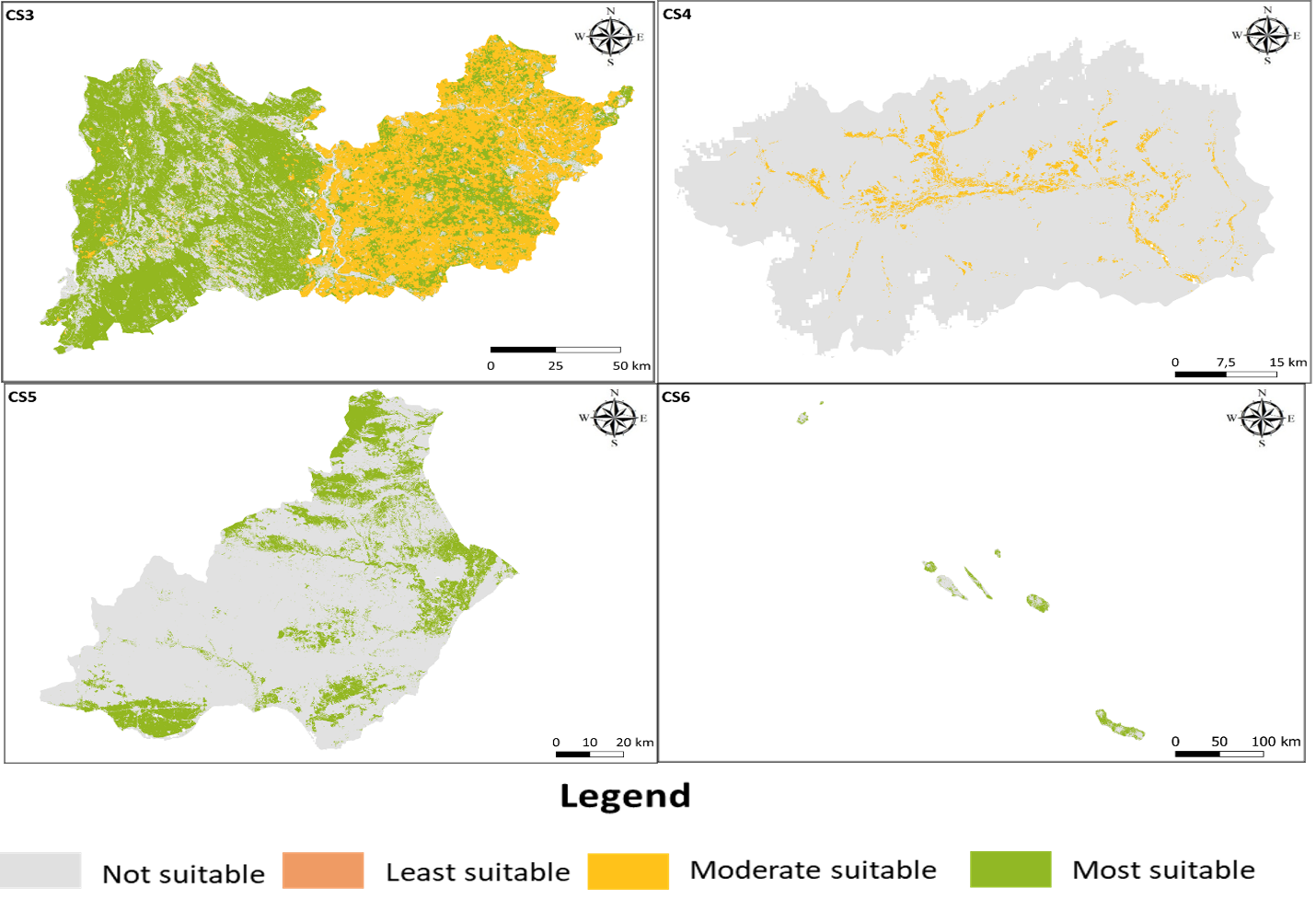
Suitability maps for four of the six cases studies, regarding the land-based adaptation and mitigation solution “Establishment (conversion to) of permanent grassland”.
As climate change accelerates, decision-makers must move beyond theoretical solutions and focus on actionable strategies. By leveraging the insights from adaptation and mitigation capacity evaluations, we can make informed choices that maximize climate resilience and carbon reduction efforts. When backed by data-driven planning and community support, land-based adaptation and mitigation solutions can be a powerful force for building a more sustainable and climate-resilient future. Now is the time to act with precision, scale with confidence, and implement with impact.
_______________________________________________________________________________
Technical note (added at 02/04/2025): The suitability maps are displayed in ETRS89-extended / LAEA Europe, an equal-area projected coordinate system centered on Europe. This projection was chosen because it preserves area, which is important for the calculations, but it distorts angles and shapes. As a result, the map may appear visually distorted, especially when compared to familiar web maps.

