
Introduction
Four years ago, the RethinkAction project began with an ambitious mission: to rethink how land-use decisions can contribute to climate adaptation and mitigation while balancing environmental, social, and economic needs. Today, as the project reaches its conclusion, it is time to look back on the journey, the main achievements, and the lessons learned. Central to this legacy is the RethinkAction platform, a pioneering digital solution that integrates scientific knowledge and participatory approaches into one coherent framework to support climate adaptation and mitigation based on land-use.
The journey of four years
The project started in 2021 with a consortium of 13 partners representing research institutes, universities, small, medium and large enterprises, and non-governmental organisations. This multidisciplinary community began to work on the research in climate and land-use modelling, assessment of land-use based adaptation and mitigation solutions (LAMS), analysis of LAMS including synergies and trade-offs, characterization of case studies, risk assessment or ICT development, with focus on stakeholder engagement as part of the co-creation processes to provide useful result in the six project case studies Gotland (Sweden), Tarn-et-Garonne (France), Southern Great Plain (Hungary), Valle d’Aosta (Italy), Almería (Spain) and Azores (Portugal).
Although the project was a challenge at the beginning and experienced delays during its implementation, the collaborative spirit of the consortium made it possible to meet the defined objectives. A clear example is the Massive Open Online Course (MOOC), where the participatory approach was essential to create a learning platform that brought together the project’s methodologies, models, solutions, and results.
At the end and through research, modelling, and stakeholder co-creation, the project produced knowledge on the effect of LAMS, highlighting how land-use choices influence not only carbon sequestration and environmental constraints, but also water availability, employment opportunities, and social acceptance.
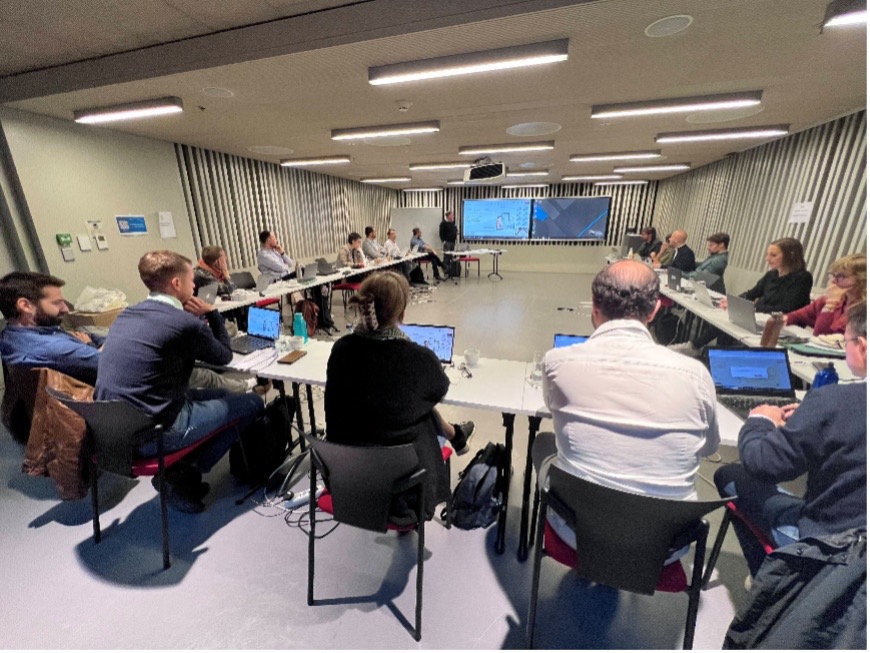
Photo: RethinkAction 3rd General Assembly (Budapest) in September 2024 (Source: CARTIF)
The RethinkAction Platform as a key outcome
At the heart of RethinkAction’s legacy stands the Integrated Assesment Platform. Designed as an interactive user-friendly and open-access tool, the platform transforms complex data and modelling exercises into actionable insights for policymakers, citizens and experts. Using the Platform, users have the opportunity to simulate their own future scenarios with the LAMS (at European or local level) once they have evaluated the baseline. Key features of the Platform are:
- Roles: Users can select their role to obtain information adjusted to their real needs. Climate projections: The platform includes downscaled Essential Climate Variables (ECVs) and derived indicators for each case study. ECVs are also provided at European level but with a coarser spatial resolution. Time series and maps are available under different scenarios and periods.
- Interactive maps: High-resolution suitability and land use maps that allow stakeholders to visualize where specific solutions can be implemented according to land constraints.
- LAMS catalogue: An interactive tool to evalaute the role of LAMS with the possibility to download specific factsheets per each LAMS.
- Risk assessment: Impact Chains (ICs) and quantified risks for each case study that include assessment of hazards, exposure and vulnerability for different scenarios and periods.
- LAMS package generator: A functional algorithm to generate packages of solutions according to the user defined priorities.
- Case study selection: Users can select a case study based on the similarities from an area that is of interest to him, regarding the project’s case studies. This is achieved through a ML similarity algorithm.
- Scenario exploration: Users can test alternative futures, assessing how different policies or land-use measures shape adaptation and mitigation outcomes.
These features make the platform a decision-support environment for stakeholders (e.g. policymakers, planners, and communities) who need to design strategies consistent with the European Green Deal, the Paris Agreement, and local sustainability goals.
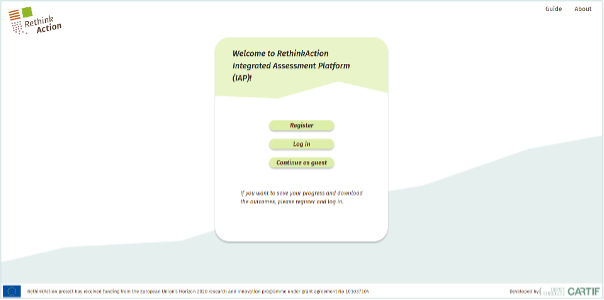
Figure: Screen shot of homepage of RethinkAction Platform
The key role of stakeholders
The platform has been co-created and tested with stakeholders across Europe. Special focus is requested for the stakeholders coming from the six case studies that represent relevant impacted areas at European level: mountain, boreal, Mediterranean, continental, Atlantic and island territories. The diverse inputs collected through the consultation processes increase the project quality helping to guide for example the implementation of the simulation engines (System Dynamic models) or the prioritization of policies to be included in the platform.
As a conclusion, the participation of stakeholders was crucial throughout all project activities, allowing the integration of real needs into the scientific and technical developments. This has enabled us to ensure that the platform responds to real-world needs and remains adaptable to future challenges, ensuring that the Platform is functional to support more sustainable futures.
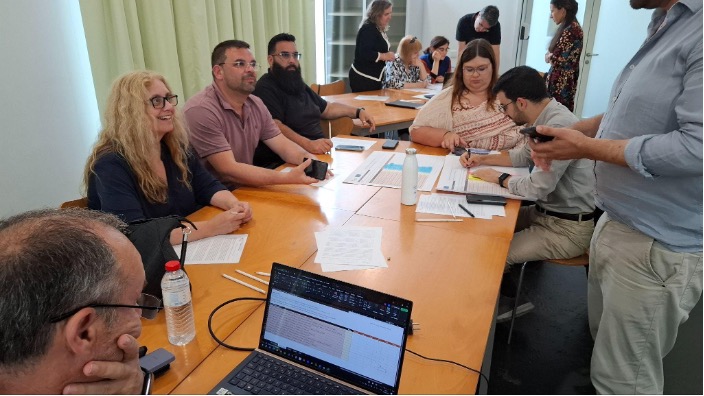
Picture taken during the five stakeholder consultation process in Azores in July 2025 (Source: FC.ID)
Impact and legacy
Looking back, RethinkAction has not only advanced scientific understanding of land-use based solutions but also created a shared space for dialogue among stakeholders and the scientific community. Its participatory approach has helped to build a bridge between science, policy, and society, which is crucial if we want research to go further and transform into solutions that address real-world problems.
The platform will remain as the main tangible legacy of the project, enabling continued exploration of sustainable land-use based strategies and scenarios beyond the project’s lifespan. It represents a step forward in making climate action more informed and inclusive.
Conclusion
The RethinkAction trip during its four years of implementation has been one of collaboration, innovation, and transformation. Throughout these years, it has demonstrated how science and technology can help empower society to rethink land use considering climate change, whose effects are becoming increasingly visible. The platform is not only a result of the project but can also be considered a lasting contribution of the consortium’s collective effort to build a solution that supports the development of a more resilient and sustainable future, with a multisectoral perspective in which actions at all scales (from local to EU and global) have a significant impact.

