

The Group on Earth Observations (GEO) post-2025 strategy presents a bold vision for a world where trusted Earth intelligence is universally accessible, empowering society to achieve a sustainable future. By adopting a user-centered, equitable, and innovation-driven approach, GEO aims to transform Earth observation (EO) data into actionable insights that address global challenges such as climate change, biodiversity loss, and land degradation.
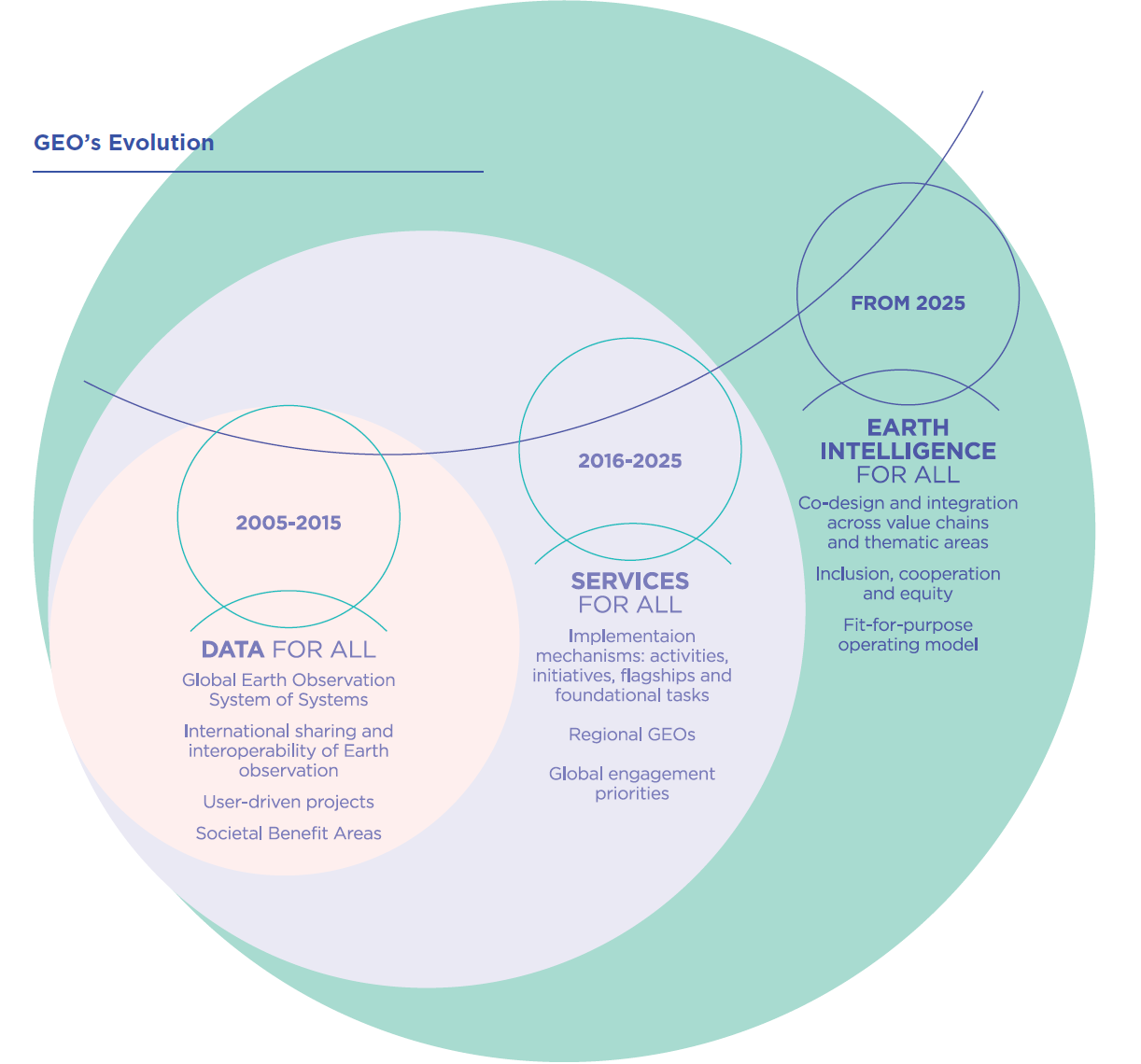
(Diagram: GEO’s evolution since 2005 and vision from 2025 onwards. Source: GEO Post-2025 Strategy.)
The Horizon 2020 project RethinkAction exemplifies how GEO’s strategic priorities can be realized in practice. Focused on sustainable land use and land management, RethinkAction aligns with GEO’s goals by providing decision-makers with a robust catalogue of Land-based Adaptation and Mitigation Solutions (LAMS) to simulate and evaluate climate action scenarios. Below, we explore how RethinkAction embodies GEO’s mission and contributes to the achievement of its post-2025 objectives.
Co-Producing Transformative Earth Intelligence Solutions: GEO’s primary goal is to co-produce transformative programs that integrate Earth and social sciences to support coherent policy decisions and unlock societal innovation. RethinkAction achieves this through its LAMS catalogue, which consolidates over 60 land-based adaptation and mitigation solutions, enriched with quantitative and qualitative data to simulate outcomes at local, national, and EU scales. The project’s foundation on Integrated Assessment Models (IAMs), such as WILIAM (Within Limits Integrated Assessment Model), highlights its commitment to cross-disciplinary collaboration. By combining EO data, socio-economic information, and stakeholder input, RethinkAction aligns with GEO’s focus on delivering Earth intelligence that informs practical, sustainable land-use policies.
Providing Needs-Based Services: One of GEO’s key commitments is to shift from a focus on EO service development to the provision of needs-based, user-oriented services. This includes identifying decision-making needs, co-designing relevant solutions, and ensuring affordability and accessibility. RethinkAction exemplifies this approach by tailoring its LAMS catalogue to meet the diverse needs of landowners, policymakers, researchers, and citizens. The solutions are characterized by metrics such as mitigation and adaptation potential, cost of implementation, and suitability factors, allowing users to select context-specific options. This flexibility supports GEO’s goal of making EO-based tools relevant and actionable for all stakeholders.
Enhancing Equity and Inclusion in Earth Intelligence: GEO’s commitment to equity entails making Earth intelligence accessible to all communities, particularly those most vulnerable to climate change impacts. RethinkAction’s open-access LAMS catalogue supports this by democratizing information on sustainable land management, making it available to a broad audience—from policymakers and scientists to local landowners and civil society organizations. Furthermore, RethinkAction actively integrates stakeholder input via dedicated workshops to ensure that the proposed solutions address real-world challenges faced by local communities. This approach aligns with GEO’s emphasis on co-designing culturally sensitive solutions that incorporate indigenous knowledge and foster inclusive decision-making.
Strengthening Capacity Building and Participation: Capacity building is a cornerstone of GEO’s strategy to bridge global knowledge gaps and enhance local capabilities. RethinkAction contributes to this objective by serving as both a research and educational tool, providing users with the information needed to implement sustainable land-use strategies effectively. The LAMS catalogue is not only a repository of solutions but also a reference point for training programs and workshops. By equipping stakeholders with the skills to interpret and apply model simulations, RethinkAction supports GEO’s aim of fostering informed decision-making and creating data-literate communities.
Addressing the Polycrisis with Integrated Solutions: The interconnected nature of climate change, land degradation, and biodiversity loss—referred to by GEO as the “polycrisis”—demands integrated, cross-sectoral solutions. RethinkAction’s comprehensive approach to land-based adaptation and mitigation directly addresses this challenge. By simulating the combined effects of land management decisions on climate, ecosystems, and socio-economic outcomes, RethinkAction provides a valuable tool for policymakers seeking to design interventions that balance trade-offs and maximize co-benefits. This aligns with GEO’s goal of delivering Earth intelligence that supports multi-dimensional solutions to complex global issues.
Fostering Cross-Sectoral Partnerships: GEO’s strategy underscores the importance of partnerships across government, academia, the private sector, and civil society to accelerate the adoption of EO-based solutions. RethinkAction’s multi-stakeholder approach, involving consultations with experts and stakeholders across various sectors, embodies this collaborative ethos. By building networks of collaboration, RethinkAction not only strengthens the science-policy interface but also contributes to the GEO community’s broader efforts to foster cross-sectoral innovation and coordination.
The GEO post-2025 strategy sets a clear pathway toward delivering user-centered, equitable, and technology-driven Earth intelligence for sustainable development. RethinkAction’s approach to sustainable land use aligns with GEO’s goals by co-producing practical solutions, integrating cutting-edge technologies, fostering inclusivity, and building capacity across stakeholder groups. As RethinkAction continues to provide valuable insights for climate adaptation and mitigation, its alignment with GEO’s strategic priorities highlights the project’s potential to serve as a model for future Earth intelligence initiatives. Through projects like RethinkAction, GEO’s vision of “Earth Intelligence for All” can become a reality—transforming data into decisions that safeguard people, ecosystems, and economies from the threats posed by climate change.
Relevant read: GEO Post-2025 Strategy, Group on Earth Observations, Geneva, November 2023, accessible from https://earthobservations.org/storage/app/media/documents/Key-Documents/GEO%20Post%202025%20Strategy%20Full%20Document.pdf

