
Today the online platforms’ market is a business in continuous expansion. According to the Global Overview research, in January 2023 64.4% of the population regularly accessed the internet (with a Year on Year growth of 1.1%), spending an average of 6 hours and 37 minutes a day while, in economic terms, according to Statista, the market capitalization of the largest digital companies has reached the value of almost 7,200 billion USD.
Additionally, the action towards climate change mitigation and adaptation is becoming one of the main priorities of investors. In economic terms, according to Morgan Stanley, more than 82% of investors are very interested in increasing their investments in sustainable sectors and assets. In particular, investors prioritized climate action with 15% ranking it first, followed by healthcare (13%), water solutions (11%) and circular economy (11%). In this context, a platform that offers solutions related to sustainability and climate change impact such as RethinkAction has a great development potential and finds a suitable environment for growth.
Within the project, RINA-C is responsible for developing an innovative business model and business plan. To this end, the Business Model CANVAS methodology has been adapted to the project purpose. The business model Canvas is a strategic management tool that provides a visual framework for developing, describing, and analyzing a business model. It helps businesses map out the key components of their operations by defining nine main blocks, as per the following image.
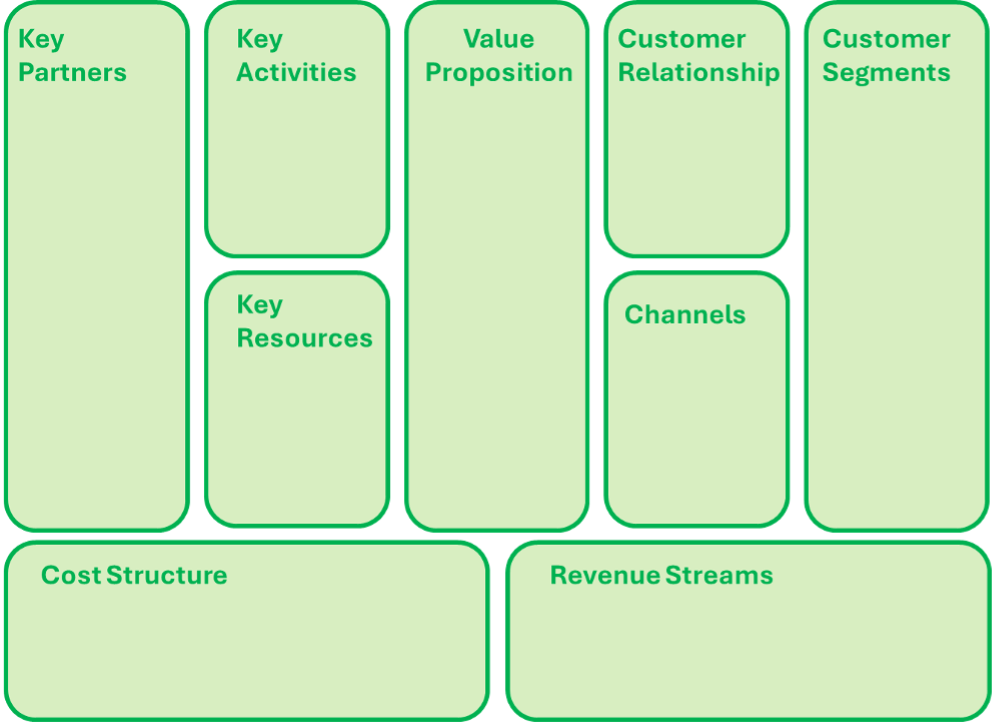
The nine blocks description is presented below:
• Customer Segments: identifies the different groups of people and organizations that the business aims to reach. In the RethinkAction-specific context, some examples of customer segments may include the End-user community, Start-ups and SMEs (small-medium Enterprises), NGOs and associations, public authorities, and private investors.
• Value Proposition: describes the unique value that the business offers to customers identified in the previous block. In the specific case of RethinkAction, the added value derived from the activity is developing solutions through participatory processes, by promoting climate action by decision-makers, stakeholders, and increasing awareness of climate change to ensure not only political but also individual behavioral changes.
• Channels: represents the various ways in which the activity can be communicated, reaching its customer segments with its value proposition.
• Customer Relationship: defines the relationship methodologies that the activity can generate with customers.
• Revenue Stream: defines the strategies and methodologies of cash flows in, or how the activity generates revenues from its clients.
• Key Resources: represents the various essential resources for the activity to continue generating its own value proposition. These resources may be physical, but also human, financial and intellectual.
• Key Activities: critical actions a business must take to operate successfully and deliver value to its customer (production, platform/network and so on).
• Key Partnership: represents the type of stakeholders that collaborate in the operation of the activity, including for example suppliers or strategic partners.
• Cost Structure: represents the cash flow outflows, that is the essential expense to continue operating the business.
The correct implementation of a business model Canvas lays the foundations for a more detailed business model that allows to define in detail the development of the economic activity.

In the vast market of digital platforms, one of the business model identified for RethinkAction is SaaS (Software as a Service). This type of model is characterized by a diversification of the cash inflows, variable according to the type of service that the digital platform in question offers to users. According to this model, different types of revenue streams are viable such as:
• Freemium: a mode that offers the basic platform features free of charge, with the possibility to upgrade to a paid subscription for more advanced features.
• Professional consulting services: this type allows to keep the platform’s functionalities and information free of charge, with the possibility of having the advice of experts in the field for certain activities.
• Partnerships and collaborations: it is a typology of revenue streams that is obtained through the conclusion of strategic alliances and systems, for example, co-marketing or cross-platform functionality.
In addition, this model allows an easy monitoring of the revenue streams using simple KPIs (Key Performance Indicators), such as the Monthly Recurring Revenue (MRR) that monitors monthly recurring revenues, the Annual Recurring Revenue (ARR) that is based on annual revenues, Customer Lifetime Value (CLV) that monitors the value a customer generates during his activity with the platform. The consortium is focusing their efforts in building a first-of-a-kind business model that takes into account all the variables described above to identify the key elements required to create a functional business, able to face the increasingly competitive digital platforms’ market.
Only one year separates us from the completion of the project. The next steps will entail outlining in more detail the characteristics of the business, in order to create a business plan capable of identifying the main features of the activity and the market context. To get more details about the RethinkAction project, and to remain informed on its future developments, follow our updates. Rethink, Act, Deliver and stay tuned!

